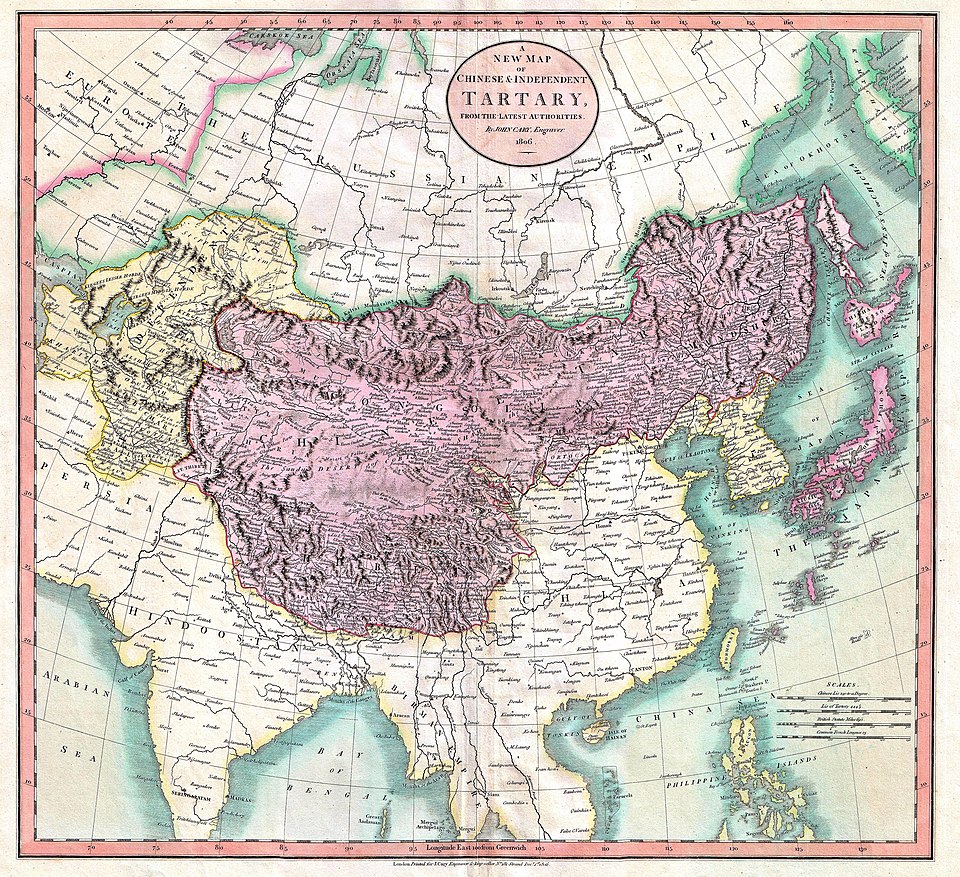
The Cartographic Evidence
Pre-1800 maps — including Ortelius (1570, Theatrum Orbis Terrarum), Mercator (1569), Blaeu (1645), and the Encyclopaedia Britannica (1771 first edition) — all prominently feature "Tartaria" or "Grand Tartary" as one of the largest political entities on Earth, spanning from Eastern Europe through Siberia to the Pacific, and including large portions of China and the Indian subcontinent. The 1771 Britannica describes Tartaria as "the greatest country in the world." By the 1800 Britannica edition, it has largely disappeared, replaced by the Russian Empire and Chinese Qing dynasty territories. The political entity that appeared on every major world atlas for 200 years effectively ceased to exist in cartographic representation within a generation, with no major war, treaty, or dissolution event in the historical record to explain it.
The New Madrid seismic zone — centred on the Mississippi River at the Missouri-Tennessee border — produced the most powerful series of earthquakes in the continental United States in recorded history: magnitude 7.2-8.1 events on December 16, 1811; January 23, 1812; and February 7, 1812. The February 7 event is estimated at magnitude 8.6 — larger than any historically recorded North American earthquake. Church bells rang in Boston. The Mississippi River temporarily reversed its flow. An eyewitness described a "mud flood" across the central Mississippi valley following the events. The cause of these earthquakes in a non-volcanic, tectonically stable region remains disputed. No satisfactory geological mechanism has been established for their extraordinary magnitude.
The Mud Flood Theory
The "Mud Flood" hypothesis — popularised by independent researchers including Martin Liedtke (YouTube: UAP) and others from approximately 2018 onward — proposes that a large-scale catastrophic event (possibly a combination of seismic activity, polar shift, or directed energy weapon) deposited metres of earth across large areas of the Northern Hemisphere in the 18th or 19th century, burying the first floors of existing buildings and killing or displacing a large portion of the population. The evidence cited includes: hundreds of buildings in Russian, European, and American cities whose ground floors are buried below street level — accessible only from below; "orphan trains" programmes (1854-1929, transporting over 200,000 orphaned children from Eastern US cities to Midwest farms) suggesting a population replacement programme; the 1893 Chicago World's Fair ("White City") buildings — photographed as new construction but showing weathering and scale inconsistent with fresh concrete construction.
Academic historians dismiss the Mud Flood/Tartaria hypothesis entirely, attributing the sunken building floors to centuries of gradual sediment accumulation, the great fires that rebuilt cities, and normal reconstruction patterns. What they do not explain: why the official historical record shows no major civilisational collapse event in the period when Tartaria disappears from maps; why hundreds of 19th-century buildings exhibit architectural complexity (free energy towers, vaulted stone interiors, embedded organ pipe structures) far beyond the stated construction technology of their period; and why population data for certain US cities in the 1800s shows growth curves that require pre-existing indigenous populations larger than any recorded.
The Smithsonian and Suppressed Giant Archaeology
Throughout the 19th century, US newspapers — including the New York Times and Scientific American — reported hundreds of discoveries of oversized human skeletons (7-12 feet in stature) by farmers, railroad workers, and archaeological excavators across the eastern United States. Many were reported sent to the Smithsonian Institution. No confirmed collection of oversized human remains exists in the Smithsonian's public collections. The Smithsonian has stated that it has no such remains. A 2014 satire article — claiming the Smithsonian admitted destroying giant skeletons — was widely shared as genuine news. But the underlying 19th-century newspaper reports are real, archived in historical newspaper databases, and have never been adequately explained. Whether the remains existed, were misidentified, or were suppressed remains an open question.