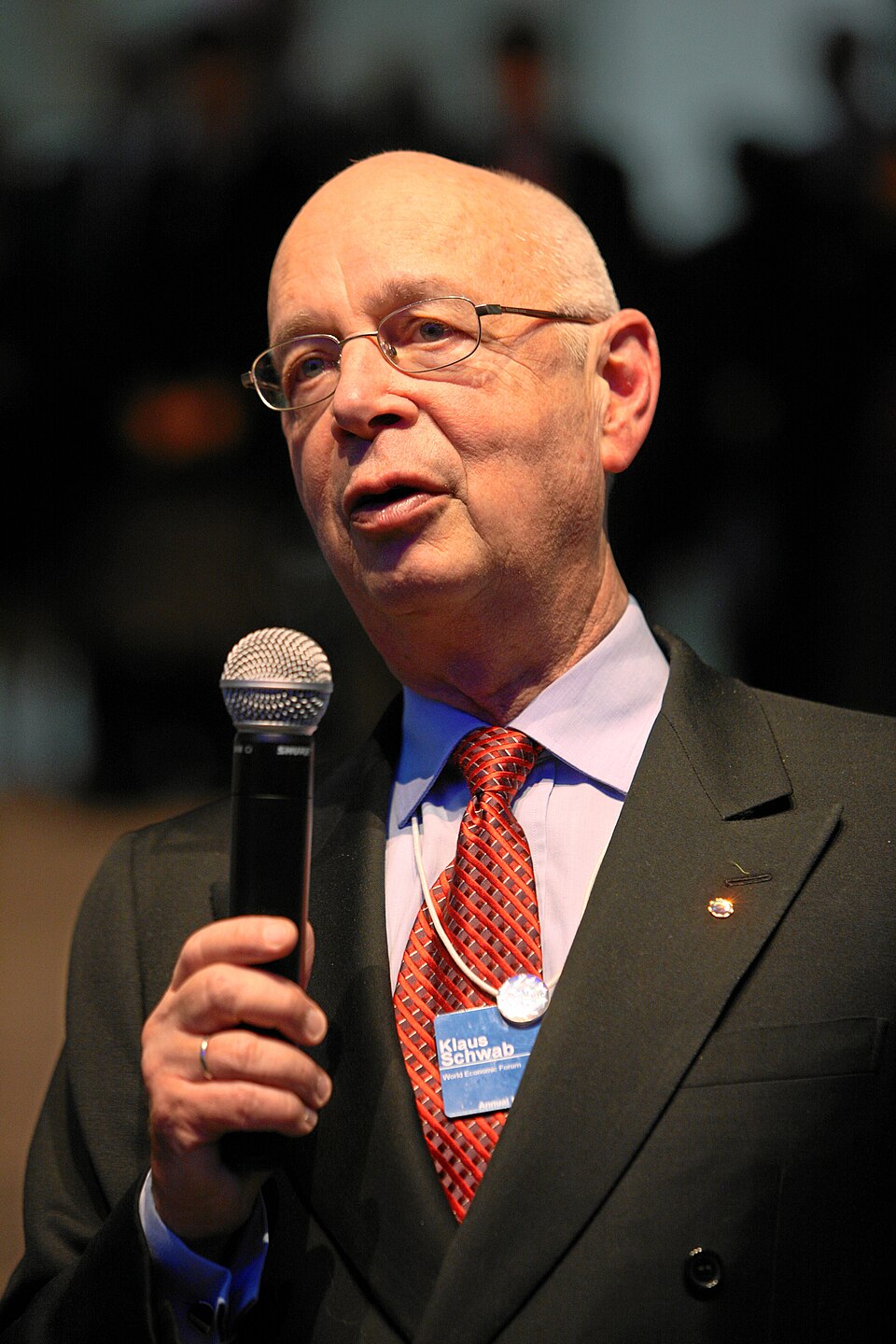
Klaus Schwab's Background
Klaus Schwab was born in Ravensburg, Germany in 1938. His father Eugen Schwab ran the Escher Wyss & Cie factory during WWII — a factory that used slave labour and produced turbines for Nazi Germany's nuclear programme and equipment for heavy water production (used in nuclear weapons research). Klaus Schwab received his doctorate from Harvard under Henry Kissinger — himself deeply connected to Rockefeller and CFR networks. Schwab founded the World Economic Forum in 1971 as the European Management Forum — initially a business management conference. Over 50 years he transformed it into the world's most influential non-governmental policy forum.
The Young Global Leaders Programme
The WEF's Young Global Leaders (YGL) programme — the renamed Forum of Young Global Leaders — has produced an extraordinary concentration of world leaders. Schwab himself boasted in a 2017 Harvard Kennedy School interview: "I have to say, when I mention our names like Mrs. Merkel, even Vladimir Putin, and so on, they are all Young Global Leaders of the World Economic Forum. But what we are really proud of now with the young generation like Prime Minister Trudeau, President of Argentina and so on, is that we penetrate the cabinets."
Documented WEF Young Global Leaders include: Justin Trudeau (Canada), Jacinda Ardern (New Zealand), Emmanuel Macron (France), Mark Zuckerberg (Meta), Jeff Bezos (Amazon), Sergey Brin & Larry Page (Google), Sebastian Kurz (Austria), Sanna Marin (Finland), Viktor Orbán (Hungary — though Orbán moved into opposition to WEF agenda), and hundreds more across government, media, academia, and corporate sectors.
In his 2018 book Shaping the Future of the Fourth Industrial Revolution, Schwab proposes that the fusion of digital, physical, and biological systems will fundamentally alter human identity: genetic modification, brain-computer interfaces, neural implants, and augmented reality will blur the boundary between human and machine. He describes this not as a warning but as an opportunity — and frames it as a governance challenge: how do existing institutions manage the transition to a humanity that is partly designed, networked, and programmable? This is not speculative. He is describing the policy framework for managing the human transhumanist transition.
The Davos Forum — The World's Real Government
The Annual Meeting of the World Economic Forum at Davos, Switzerland each January is the single most concentrated gathering of global power outside of closed-door intelligence meetings. Approximately 2,500-3,000 attendees include: heads of state from 50+ countries, CEOs of the world's 1,000 largest corporations, editors and publishers of major media, leaders of international organisations (IMF, World Bank, WHO, UN), and invited academics and activists chosen to provide ideological support for the agenda. Davos does not vote on policy — it creates policy consensus through private sessions, working groups, and informal conversations that then emerge as "global priorities" in the following year's institutional activity. It is the real coordinating body for global governance — operating entirely outside any democratic mandate.
Penetrating the Cabinets
The WEF's explicit strategy is to place YGL alumni in cabinet-level positions within national governments, so that when the WEF's annual consensus positions — on climate, trade, health, migration, AI governance — are "recommended" to member governments, the officials implementing them are WEF-aligned. This is not conspiracy theory: it is Schwab's documented strategy, stated in his own words on video.
Stakeholder Capitalism vs. The People
"Stakeholder capitalism" — Schwab's central economic doctrine — replaces the shareholder model (companies serve shareholders) with a model where companies serve all "stakeholders" including society, governments, and the environment. The appointed arbiter of what "society" needs is, in Schwab's framework, the WEF itself and its partner institutions. Democracy is replaced by "multi-stakeholder governance" where WEF-connected institutions speak for humanity without electoral legitimacy.