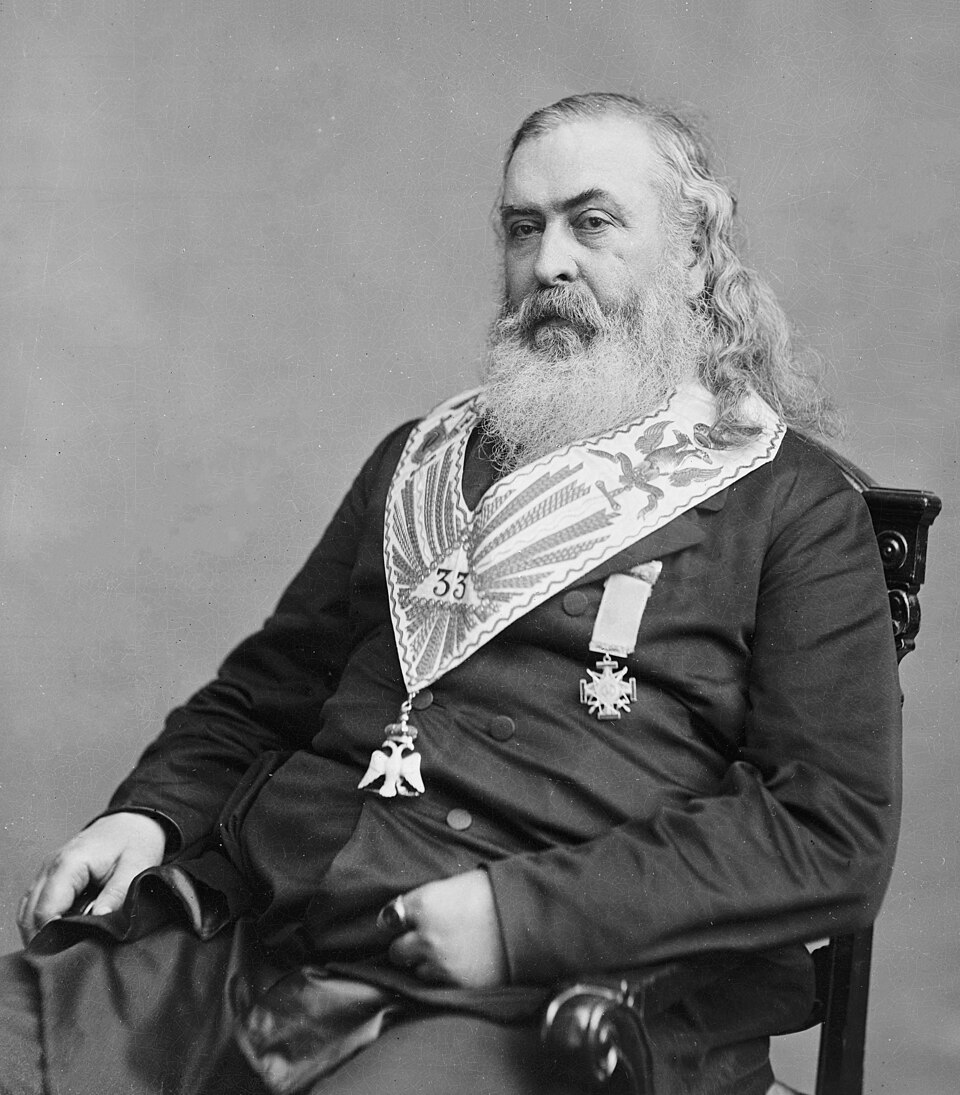
Albert Pike and the Three World Wars
Albert Pike — Grand Commander of the Scottish Rite of Freemasonry from 1859 to 1891 — wrote in Morals and Dogma (1871): "Lucifer, the Light-bearer! Strange and mysterious name to give to the Spirit of Darkness! Lucifer, the Son of the Morning! It is he who bears the Light, and with its splendours intolerable blinds feeble, sensual, or selfish Souls? Doubt it not!" This passage — in the defining doctrinal text of Scottish Rite Freemasonry — is not a description of the enemy. It is a declaration of worship. Pike is explicit: Lucifer is the deity of Freemasonry's inner circle, distinct from the Adonai (God of the Bible) who is the deity of the outer or lay membership who do not receive the inner teaching.
A letter allegedly written by Pike to Giuseppe Mazzini in 1871 — describing three world wars — has been cited repeatedly, including in Edith Starr Miller's Occult Theocracy (1933) and William Guy Carr's Pawns in the Game (1958). The letter describes: a First World War to overthrow the Tsars and establish communism; a Second World War to build the State of Israel; a Third World War between Islam and Zionism to destroy both, creating a vacuum for Luciferian doctrine to fill. The authenticity of the letter is disputed — it never appeared in the British Museum collection where it was alleged to reside. But the accuracy of its predictions for the first two wars has attracted continued interest. Its origin remains unresolved.
Helena Blavatsky — founder of Theosophy (1875) and author of The Secret Doctrine (1888) — wrote extensively in praise of Lucifer, stating: "Lucifer is divine and terrestrial light, the 'Holy Ghost' and 'Satan' at one and the same time" and "the Fallen Angel... is humanity itself." Blavatsky's Theosophical Society attracted an extraordinary concentration of future globalist institution builders: its members or direct intellectual heirs included Alice Bailey (whose Lucis Trust — originally the Lucifer Publishing Company — has consultative status at the United Nations and publishes UN material), Annie Besant (president of the Indian National Congress), and her student Jawaharlal Nehru (India's first Prime Minister). Alice Bailey's Lucis Trust office is located at the United Nations Plaza in New York City.
The UN, the Lucis Trust, and the Meditation Room
The United Nations Meditation Room — a non-denominational "meditation space" at UN headquarters, open to all faith traditions — was designed by Dag Hammarskjöld and contains a single central object: a 6.5-tonne polished magnetite block (described as an "altar" by Hammarskjöld). The room's design was specified with input from the Lucis Trust. Robert Muller — former UN Under-Secretary-General and the architect of UNESCO's World Core Curriculum — based his educational philosophy explicitly on Alice Bailey's Theosophical teachings. Muller described himself as a disciple of Bailey's. The curriculum he designed — adopted by multiple national education systems — explicitly aims to create planetary citizens who have transcended national and religious identity.
Inversion as Ritual — The Signature
The consistent signature of Luciferian ritual and philosophy is inversion: what is sacred in conventional religion is profaned; what is forbidden is performed; the symbols of good are reversed. The inverted cross, the inverted star, the reading of sacred texts backwards — these are not aesthetic choices. They are deliberate inversions of established sacred symbolism, reflecting the philosophical position that the established moral order is itself the prison from which "illuminated" humanity must escape. This is why demonic imagery appears in Grammy performances, why Satanic Temple monuments parody Ten Commandments displays, why the "as above so below" principle (Hermetic, not Christian) is the operating philosophy of the elite's public architecture: the Washington DC street layout, the Eye of Providence on the dollar bill, the capstone-less pyramid at Giza. In Luciferian doctrine, these are not decorations. They are statements of theological intent.